
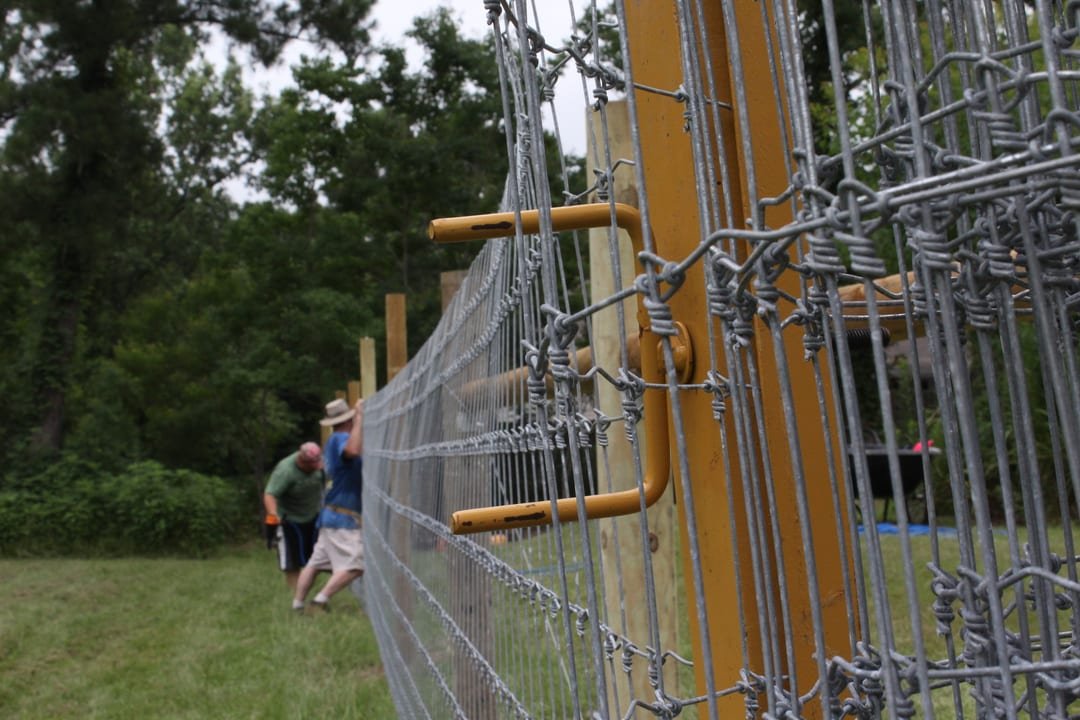
Whether you are building a fence yourself or just want to know what the crew is unloading, the tools tell you most of what the job is. Here is what each fence style takes, from a short picket fence to a stretched wire line. Rent the expensive ones; buy the cheap ones you will use again.
Every fence
- Tape measure, string line and stakes, a four-foot level and a post level.
- Post hole digger and a digging bar for roots and rock; an auger for anything more than a dozen holes.
- Wheelbarrow or mixer for concrete, a hose and a shovel.
- Circular saw, drill driver and a reciprocating saw for the odd cut.
- Gloves, eye protection, and a first-aid kit. Fence work cuts people.
Wood privacy, picket and horizontal fence
- Framing nailer with galvanized ring-shank nails, or a drill and coated screws for horizontal boards.
- Speed square and chalk line for level rails and trimmed tops.
- Clamps for holding rails while fastening.
- Spacer blocks for picket gaps.
- Sawhorses and a table or miter saw for a lot of cuts.
See building a three-rail privacy fence with a rot board for the method.
Chain link
- Come-along and a fence stretcher bar to pull the fabric.
- Pipe cutter or a grinder for rails and posts.
- Fence pliers and hog-ring or tie pliers.
- Socket set for tension bands, rail ends and gate hardware.
See chain link fence.
Barbed wire and field fence
- T-post driver and a T-post puller.
- Fence stretcher for barbed wire and a stretcher bar with a come-along for woven wire.
- Fence pliers, wire cutters, a crimping tool and sleeves for splices.
- Staple hammer or a long-handled hammer for wood posts.
- Brace wire, a twist stick, and a tamping bar for set posts.
- Chainsaw and loppers if the line needs clearing.
See barbed wire, field fence and building a proper H-brace.
Cattle and hog panels
- T-post driver, bolt cutters to trim panels, and panel clips or tie wire with pliers.
- A helper. Panels are two-person work.
See cattle panel fence.
Gates
- Drill with long bits for hinge bolts, wrenches for hinge pins, a level, and shims or blocks to hold the gate while hanging.
- For a wood gate, a square and a steel brace kit or stock for the diagonal.
See gates.
Worth renting
A tractor or two-person gas auger, a hydraulic post driver for a long wood-post line, a fence stretcher if you do not own one, and a trailer for the material. Worth buying: fence pliers, a good level, a post level and gloves. DIY versus professional fence installation helps decide whether to rent the tools or the crew.
Frequently asked questions
What tool is most worth renting?
A gas or tractor auger for post holes. Digging a privacy fence by hand in clay or roots is the thing that turns a weekend project into a month. A fence stretcher for wire fence is the other one.
Do I need a nail gun?
For a privacy fence, it is the difference between a day and a week. For a short picket fence or a repair, a hammer is fine. Use galvanized ring-shank nails either way.
What tool do people forget?
A string line and a level. A fence built without them is crooked, and crooked is the one thing a fence can never fix later.