
A stretched wire fence, barbed wire, field fence or game fence, is pulling on its corners every minute it stands. The pull is in the hundreds of pounds, and it never lets up. A single post, however deep, leans under that over a season or two, and then the whole run goes slack. The H-brace is the assembly that holds the pull, and it has been doing it on Texas fence lines for a hundred years. We build them on every corner, end and gate of every wire fence, and we rebuild a lot of them that other people built wrong. Here is how one goes together.
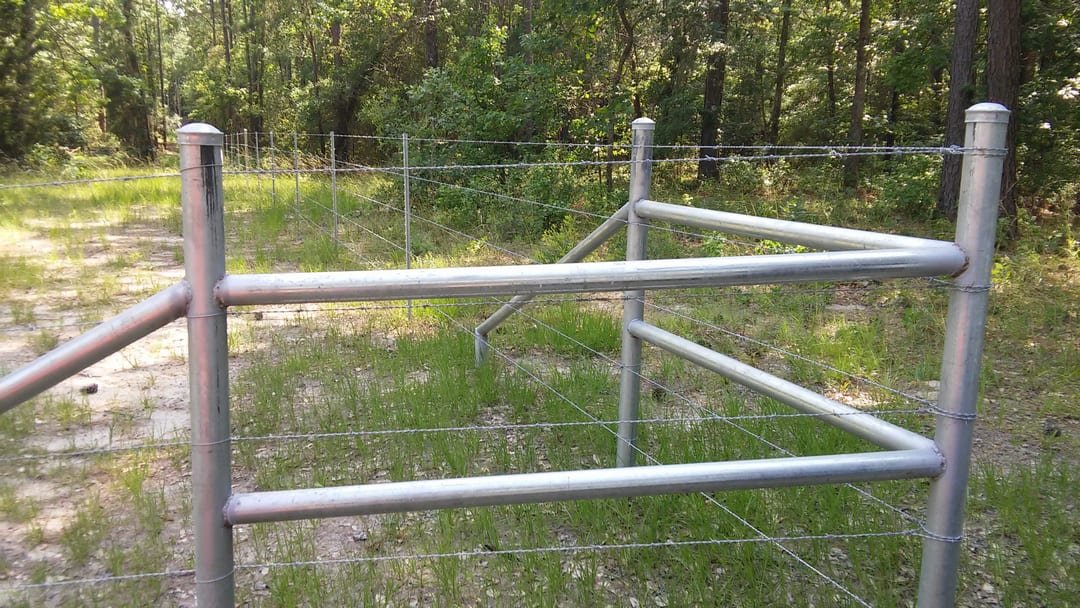
The parts
- Corner post. The heavy post the fence pulls on. Treated wood, at least five inches, or pipe. Set deep, in concrete or tamped very tight.
- Brace post. A second post in line with the fence, eight feet or more from the corner, set the same way.
- Horizontal brace. A post or pipe between the two, notched or pinned in near the top, that keeps them apart.
- Brace wire. A loop of smooth galvanized wire from the bottom of the corner post to the top of the brace post, twisted tight with a stay.
Why it works
The fence pulls the top of the corner post toward the run. The horizontal brace pushes that pull across to the brace post. The brace wire, running diagonally from the base of the corner post up to the top of the brace post, keeps the whole frame from racking into a parallelogram. The result is a rigid rectangle that spreads the pull of the fence over two posts, a brace and a lot of soil, instead of one post.
Building it
- Set the corner post. Dig below the soft soil, deeper than the line posts, and set it in concrete or tamp it in tight in lifts. Plumb it.
- Set the brace post in line with the fence run, eight feet from the corner for a standard fence, the same depth and the same care.
- Fit the horizontal brace. Notch or pin it into both posts a few inches below the top, level, so it cannot drop or roll.
- Run the brace wire. Staple one end low on the corner post, wrap it around, up to the top of the brace post, around and back, two full loops. Low on the corner, high on the brace post. Not the other way.
- Twist it tight. Put a stick or a steel stay between the loops and twist until the wire is taut and the frame is rigid, then leave the stay in place against the brace.
- Let the concrete cure before you stretch wire against it.
Common mistakes
The brace wire run backwards, which pulls the corner over. A short brace, which gives no leverage. The brace post set shallow because it "does not carry the fence." Stretching wire before the concrete has set. Using the H-brace as a gate post, so the gate's weight works against it. And skipping the brace at a dip or a rise, where the fence pulls up or down on a post the same way it pulls sideways at a corner.
When you need more
Long pulls, tall fence and heavy wire need a double H-brace: two bays in line, with the brace wire in each. Eight-foot game fence always gets one. Gate posts get their own brace back into the fence line, separate from the corner. See barbed wire fence, field fence and game fencing for where each applies. If you would rather we set the corners and braces and you string the wire, that is a common arrangement on ranch jobs; ask on the estimate.
Frequently asked questions
Which way does the brace wire run?
From the bottom of the corner post, the one the fence pulls on, up to the top of the brace post. Run the other way it pulls the corner post over instead of holding it. This is the single most common H-brace mistake.
How long should the horizontal brace be?
At least twice the height of the fence above ground; eight feet is standard for a four- to five-foot fence. A short brace does not give enough leverage and the corner leans.
Do I need a double H-brace?
On long runs, on game fence, and anywhere a lot of wire pulls on one corner, yes: two bays of brace in line. A single H is fine for most pasture fence under a few hundred feet per pull.