
Look at a wood privacy fence anywhere around Lake Livingston and the odds are the pickets have their top corners clipped at an angle. That is a dog-ear picket, and it is the default for a reason. It is not the only choice, and we build the others, but if you are not sure what you want, it is the one to start from.
Why dog-ear works
- It sheds water. A square-topped picket holds water on its flat end grain, which is where rot starts. The clipped corners give water somewhere to go.
- It hides small differences. Pickets are never exactly the same length. On a flat-top fence every eighth of an inch shows. The dog-ear softens the top line so the fence reads as even.
- It is economical. Dog-ear pickets are the standard stocked size in cedar and treated pine, which keeps the material cost down and the supply reliable.
- It looks right on most houses. It is the familiar Texas backyard fence. It does not fight with the architecture, and it takes stain well.
Dog-ear as a privacy fence
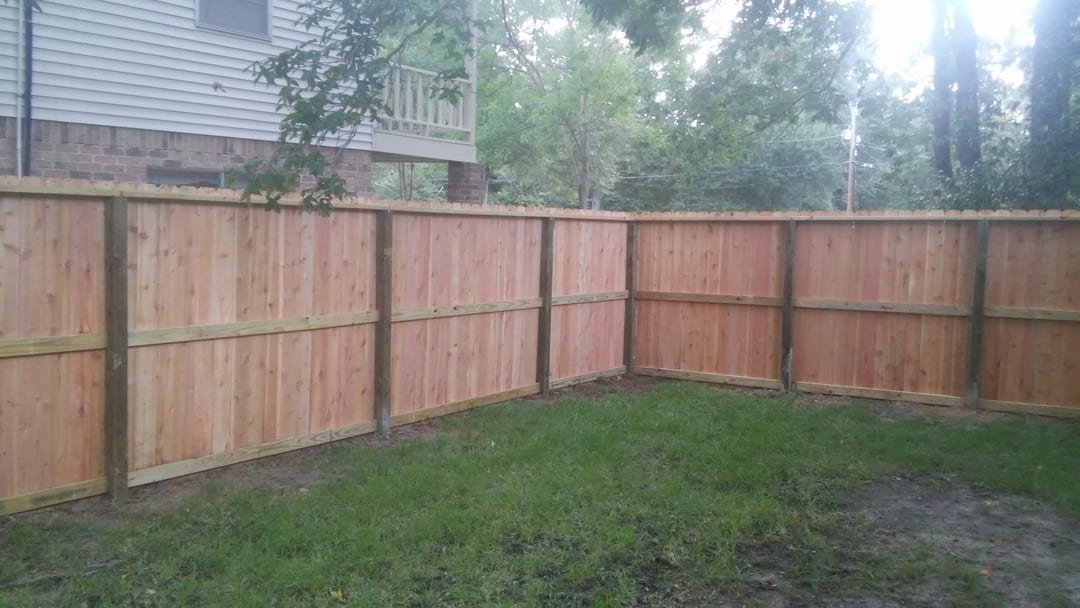
Set edge to edge on three rails with a rot board, dog-ear pickets make the standard six-foot privacy fence. As the wood dries, small gaps can open between flush pickets, so where full privacy matters for the long term we build board-on-board: pickets overlapped on alternating sides of the rails, which stays private as the boards shrink and looks finished from both sides. Building a three-rail privacy fence with a rot board covers the construction.
The alternatives
Flat-top pickets give a cleaner, more modern line and usually get a cap rail and trim board to finish the top edge, which also protects the end grain. Gothic or pointed pickets read traditional and are more common on short picket fences than on privacy fence. Shadowbox alternates pickets on each side of the rails with a gap, for airflow and a two-sided look with partial privacy. Horizontal boards are a different fence altogether; see horizontal fence. Adjust your privacy like never before walks through how open or solid each option is.
Cedar or treated pine pickets
Dog-ear pickets come in both. Cedar costs more, resists rot on its own and stays straighter; it is the pick for a natural or clear-stained fence. Treated pine costs less and does well under a solid stain or paint. Either way, the posts and rails underneath are treated pine, and the finish schedule is every two to four years. See wood fence and staining.
Height and rules
Six feet is standard; eight feet for road frontage and pools, built heavier. Subdivision deed restrictions sometimes cap height or require a particular picket style out front, and we check before building. Privacy fence has the rest.
Frequently asked questions
What does "dog-ear" mean?
The two top corners of the picket are clipped at an angle, so the top looks a little like a folded dog ear. It is the standard picket shape at lumber yards across Texas.
Are dog-ear pickets good for privacy?
Yes. Set edge to edge or board-on-board, dog-ear pickets make a fully private fence. The clipped corners just soften the top line and shed water better than a square corner.
Dog-ear or flat-top?
Dog-ear is the everyday choice: economical, forgiving of weather, and the clipped corners hide small differences in picket height. Flat-top looks cleaner and more modern and usually gets a cap rail to finish it. Both are built the same underneath.