
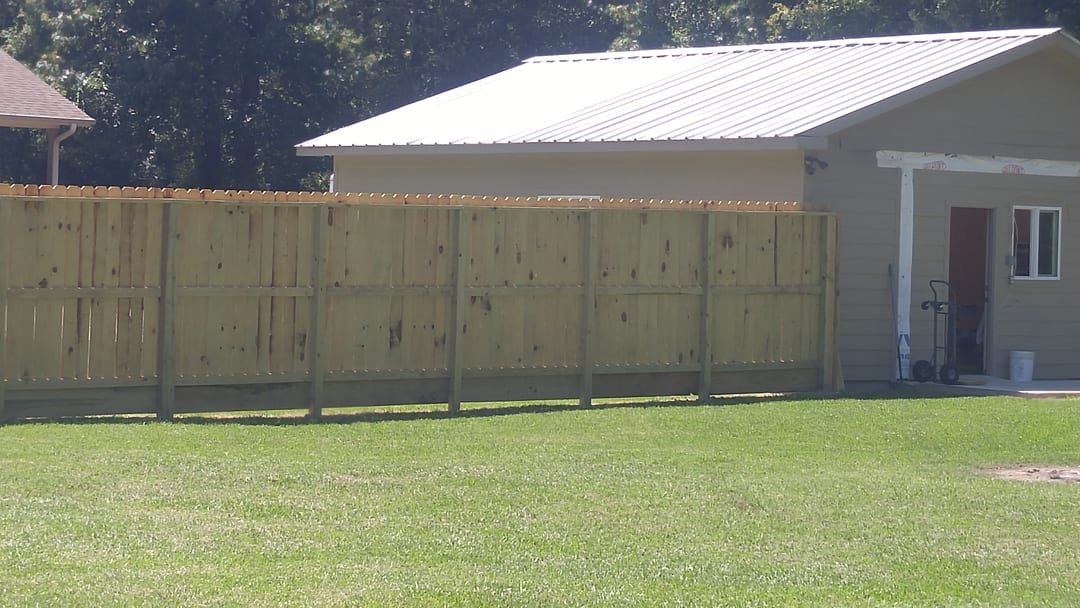
Most people think of privacy as a switch: a solid six-foot fence, or an open one. In practice it is a dial, and the fences around Lake Livingston that people like best are usually set somewhere in the middle: enough screening to feel enclosed, enough openness to keep a breeze and a view. Here is the range, from open to solid, and where each setting fits.
Open
Split rail, cross buck, ornamental and aluminum mark a line and hold a dog without hiding anything. The setting for front yards, driveways and the water side of a lake lot.
Mostly open
A picket fence with normal spacing, or a horizontal fence with wide gaps. You see through it easily but it reads as a boundary. Good around patios and gardens near the house.
Half and half
Shadowbox: pickets alternate on each side of the rails with a gap, so the fence is solid straight on and open at an angle, with airflow and the same look from both sides. Spaced horizontal boards with a narrow gap do the same with a modern line. Chain link with slats blocks most of the view and lets air through. The setting for side yards, pool areas and patios where you want enclosure without a wall.
Mostly solid
A solid privacy fence below with a lattice topper above, which adds height, light and air to a solid fence. Or a solid fence that stops at five feet instead of six. Common where a neighbor is close but the yard should not feel boxed.
Solid
Six- or eight-foot privacy fence in flush-board or board-on-board, or R-panel for a metal wall. The setting for road frontage, pools, equipment yards and anywhere noise or a direct view has to stop. What goes into an eight-foot fence covers the tall end.
Mixing settings on one lot
The best lake-lot fences use two or three settings: solid along the road and between neighbors, half-and-half around the patio, open toward the water. The styles meet at corner posts and read as one design when the wood and the heights are coordinated. We lay this out with you on the estimate, walking each side and asking what you want to see and not see from where you sit.
Screens: privacy where you need it only
Sometimes the problem is one window or one air conditioner, not a whole lot line. A short privacy screen solves that without fencing anything. It is the most adjustable option of all.
Frequently asked questions
Can one fence be private on one side of the yard and open on another?
Yes, and on a lake lot that is the normal design: privacy fence between neighbors and along the road, open fence toward the water. The two meet at a corner post and look intentional.
Does a shadowbox fence give real privacy?
Straight on, mostly. At an angle, you can see through the gaps. It is the choice when you want airflow and a two-sided look more than total screening.
Can privacy be added to an existing open fence?
Often. Slats in chain link, a screen panel on a rail fence, or a lattice topper on a short fence all add privacy without replacing it, as long as the posts can take the extra wind load.