
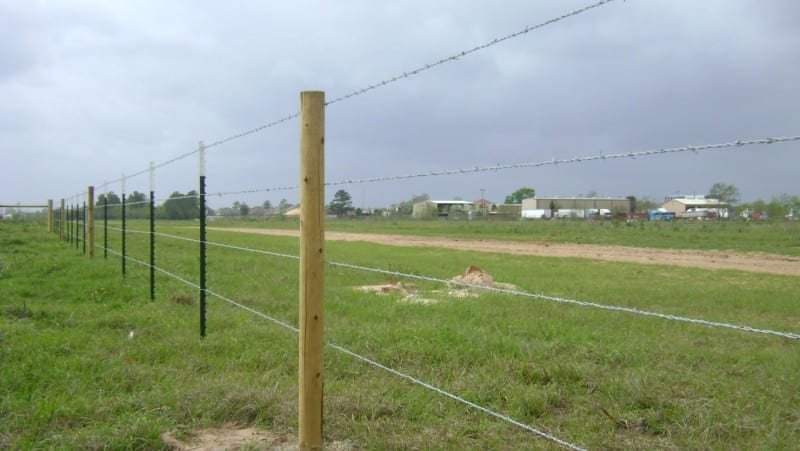
Barbed wire has fenced Texas for a century and a half, and around Lake Livingston it still holds more cattle than every other fence combined. It is cheap per foot, fast to build, handles long runs and rough country, and lasts for decades when the corners are right. Here is when to choose it, when not to, and how it should be built.
Reasons to choose barbed wire
- Cost per foot. Nothing holds cattle for less.
- Long runs and rough ground. It follows terrain, crosses creeks with a water gap, and runs for miles on T-posts.
- Cattle respect it. Once they learn it, they stay off it.
- Speed. A crew with a driver and a stretcher builds a lot of it in a day.
- Lifespan. Class 3 wire on braced corners lasts decades with a yearly walk.
Reasons to choose something else
Horses: never. Goats, sheep and small stock walk through it; use field fence. Yards, gardens and anywhere people and dogs are close to it: use rolled wire or a yard fence. Working pens, where animals are crowded: panels, pipe or boards.
Best practices in construction
- Clear the line and find the property pins before anything else.
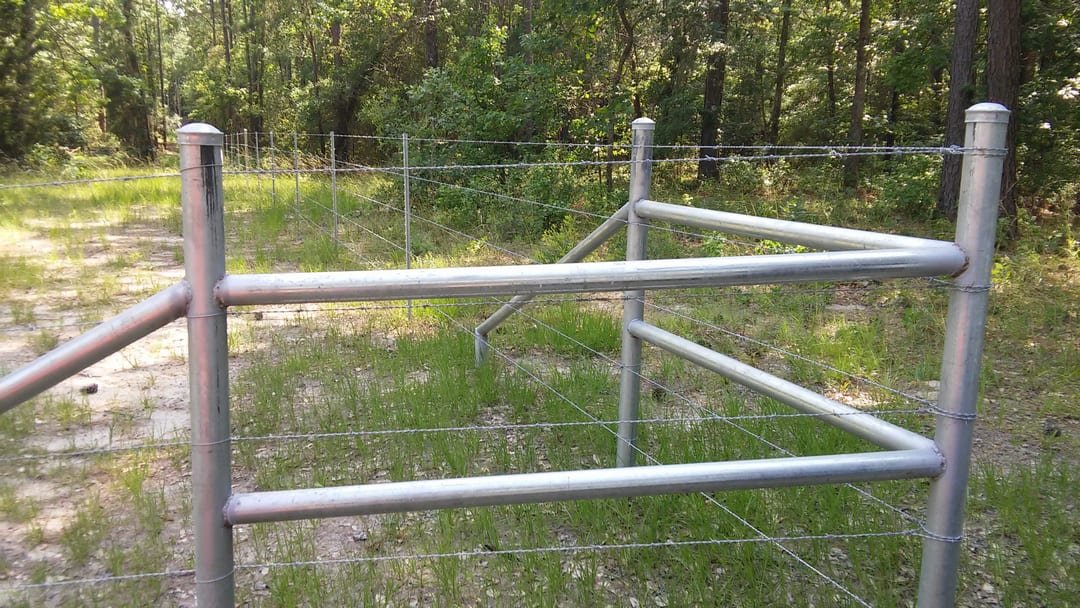
- Build the corners. H-brace assemblies at every corner, end, gate and at the bottom of every dip: heavy posts set deep, a horizontal brace, a diagonal brace wire run from the bottom of the corner to the top of the brace post. How a proper H-brace goes together.
- Drive the line posts. T-posts on 10- to 12-foot centers on level ground, closer on rises and dips, with the anchor plate buried.
- Four or five strands, spaced for the stock, with the bottom strand set to hold calves without snagging them.
- Stretch each strand with a stretcher to a proper tension, tie off at the braces, clip to every T-post and staple to wood at an angle.
- Stays between posts on long spans to keep strand spacing.
- Gates where you drive and walk, on their own braced posts, sized for the trailer.
Best practices for building a barbed wire fence goes deeper on spacing, strands and safety.
Wire and hardware
Class 3 galvanized, two-point or four-point, 12½ gauge. Light-coated wire rusts through in a few years in the lake humidity and is a false economy. Galvanized clips and staples, twisted brace wire with a stay. See barbed wire fence for where and how we build it.
Frequently asked questions
Is barbed wire legal around a house?
On acreage and pasture, yes, and it is everywhere. Inside some city limits and subdivisions it is restricted. It is also the wrong fence for a yard where people and pets are near it, whatever the rules say.
How long does barbed wire last?
Class 3 galvanized wire on braced corners lasts decades. The wire outlasts the posts; the posts outlast the corners if the corners were built wrong.
Does it hurt cattle?
Cattle learn a barbed wire fence fast and respect it. It is horses, with their thin skin and panic reflex, that barbed wire injures, which is why we never build it where horses run.