
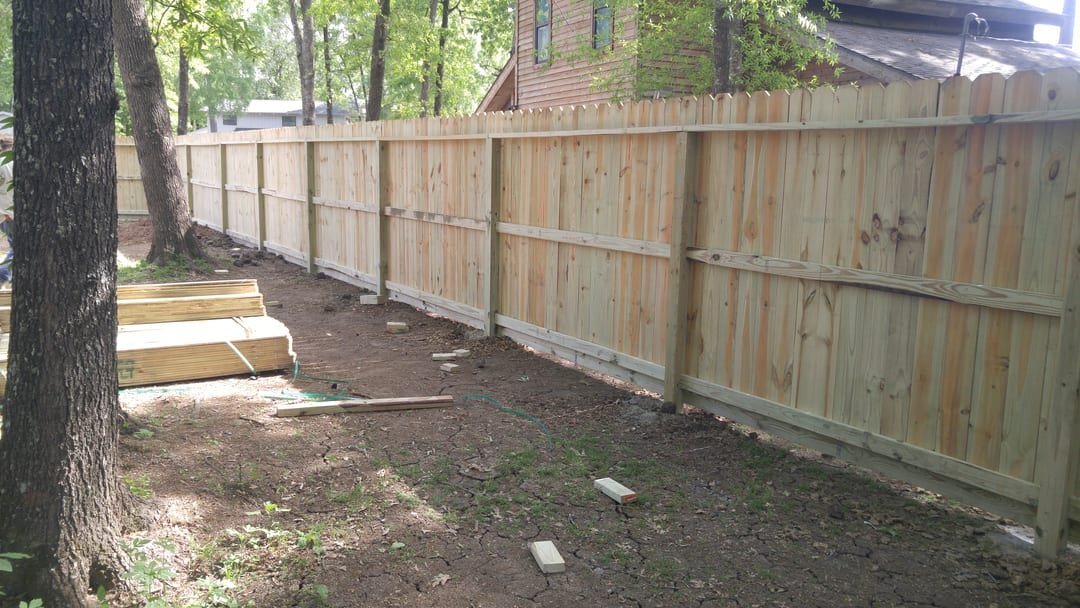
Six feet is the standard privacy fence. Eight feet is what people ask for when six is not enough: a busy road, a commercial neighbor, a pool that needs real screening, a yard that sits below the property next door, or noise that a six-foot fence only takes the edge off. An eight-foot fence does all of that. It also catches a third more wind on a third more lever arm, which is why it has to be built differently and not just taller.
Where eight feet earns its cost
- Road and highway frontage, for sight and sound.
- Commercial and industrial neighbors, equipment yards, dumpster areas.
- Yards that sit lower than the lot next door, where six feet is five feet from the neighbor's porch.
- Pools and patios that need to be fully screened.
- Noise from a road, where mass and height both help.
What changes from six to eight
- Posts. Four-by-six or six-by-six treated posts, or steel, instead of four-by-fours. The post is the lever the wind pushes on, and a four-by-four at eight feet flexes.
- Depth and concrete. Holes deeper and wider, with more concrete, so the post has enough ground holding it against the extra load. On soft or sandy ground, deeper still.
- Four rails, not three. An eight-foot picket on three rails has too much unsupported board. The fourth rail keeps pickets flat and stiffens the panel.
- Post spacing. Still eight feet on most lots; six feet on an exposed site where wind comes across open ground or water.
- Longer pickets, which cost more and are straighter in cedar than in pine.
- Gates built on steel frames. An eight-foot wood gate is heavy; a steel frame under the wood keeps it square.
Wind
A solid fence is a sail. Six feet of it is manageable on standard posts. Eight feet on the same posts fails in the first good storm across the lake, which is why we will not build it that way to lower a price. On an exposed site we talk about tighter post spacing, a shadowbox or a lattice top to let some air through, or R-panel on a steel frame, which handles wind better than wood at that height. See R-panel fence.
Rules
Many cities and subdivisions cap residential fence height at six feet, with exceptions for certain frontages or commercial boundaries, and some require a permit above a certain height. We check the rules for your lot before quoting an eight-foot fence, so the fence we build is one you get to keep.
Board-on-board at eight feet
Tall fence shows gaps more as the wood dries, so board-on-board is a good match at eight feet: overlapping pickets stay private and the fence looks finished from both sides. It also adds weight, which argues again for the heavier posts. Privacy fence covers the styles and the three-rail build is the base this one grows from.
Alternatives to eight feet
A six-foot fence with a lattice topper reaches seven feet with less wind load and a lighter look. A six-foot fence plus a row of fast-growing shrubs screens a second-story window better than eight feet of wood. A berm along a road does more for noise than any fence. We will say which fits when we see the lot.
Frequently asked questions
Is an eight-foot fence allowed?
It depends on where the lot is. Many cities and subdivisions cap residential fence at six feet, sometimes with exceptions for road frontage or commercial boundaries. Unincorporated county land usually has no limit. We check before we price it.
How much more does eight feet cost than six?
More than a third more, usually. The pickets are longer, there is a fourth rail, the posts are bigger and deeper, and the holes take more concrete. The exact difference depends on the site, which is why we quote each one.
Can an eight-foot fence be built in metal?
Yes. R-panel on a steel frame and tall chain link with slats are both common at eight feet for commercial screening, and both handle wind well when the posts are built for it.