
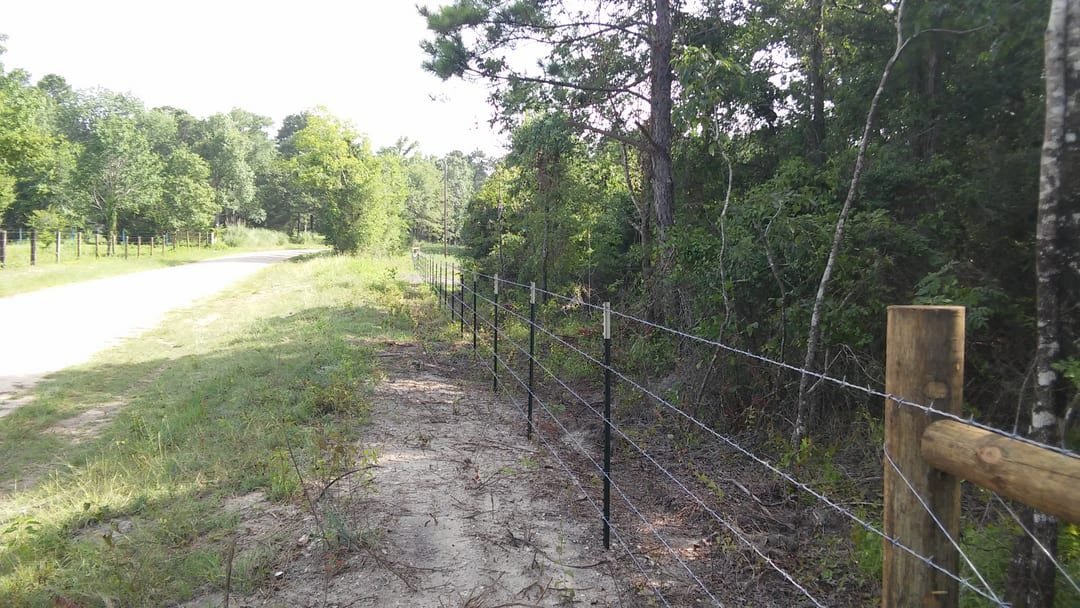
Walk any pasture fence in Polk or San Jacinto County and most of the posts holding it up are steel T-posts. They drive in minutes, cost a fraction of a set post, do not rot, and clip to any wire or panel. They have one limit, which is that they cannot hold a pull, and everything about building a good T-post fence follows from that.
Reasons to choose T-posts
- Cost. The least expensive line post there is.
- Speed. Driven, not dug; a crew sets hundreds in a day.
- No rot. Steel in wet ground outlasts wood in wet ground.
- Versatile. Barbed wire, field fence, welded wire, panels and electric all clip to them.
- Easy to pull and reuse when a fence moves.
What T-posts cannot do
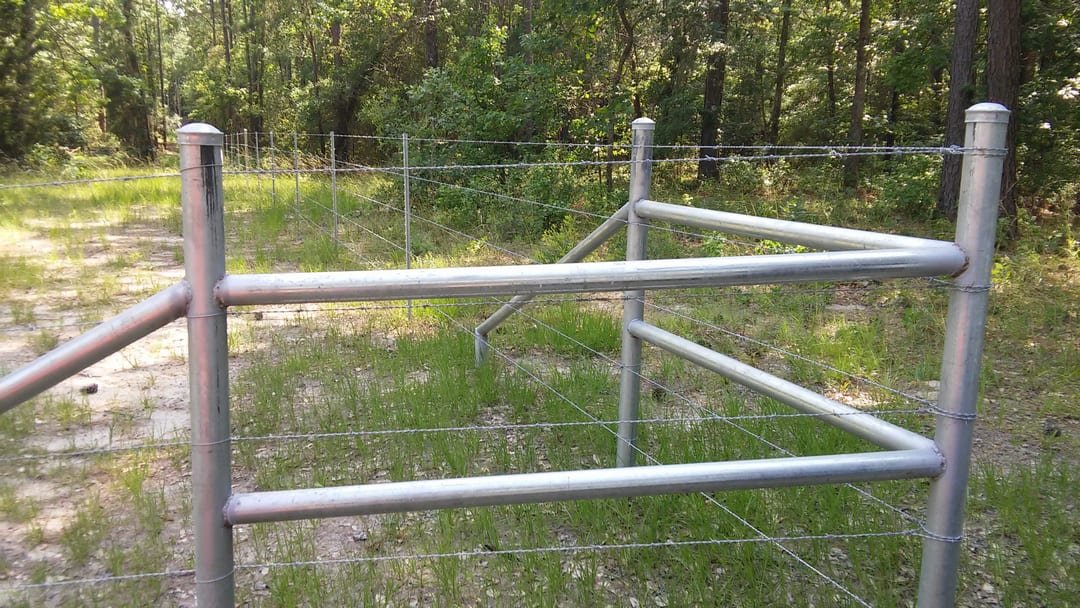
Hold a corner, an end, a gate or a brace. A T-post bends under a stretched fence's pull or a gate's weight. Those points get wood or pipe posts set deep, built into H-braces where wire is stretched. The T-posts just hold the wire up between them. Building a proper H-brace is the companion to this article.
Best construction practices
- Anchor points first. Corners, ends, gates and braces in wood or pipe, set in concrete or tamped tight, cured before any wire is stretched.
- Sight the line. A string or a sight between braces so the posts go in straight.
- Drive to depth with a post driver, until the anchor plate is buried, plumb, studs toward the animals.
- Space for the fence and the ground. Ten to twelve feet for barbed wire on level ground; eight to ten for field fence; four to eight for panels; closer at every rise and dip.
- Stretch the wire between the braces, then clip it to each post with galvanized clips; the posts hold height, the braces hold tension.
- Cap or sleeve T-posts where horses or people are near the tops.
- Walk it yearly; a leaning T-post almost always means a brace behind it has moved.
Posts and clips
Standard 1.25-pound-per-foot or heavier studded posts, painted or galvanized, in the length that leaves the right height for the fence. Galvanized clips. See T-post fence, and driving posts versus setting posts for when a driven post beats a set one.
Frequently asked questions
Which way do the studs face?
Toward the animals, so the wire sits on the inside of the post and a pushing animal loads the post, not the clips.
How long a T-post do I need?
Fence height plus the depth you drive, usually 18 to 24 inches. A five-foot fence takes a six-and-a-half- to seven-foot post.
Do T-posts rust?
Painted posts rust slowly at the ground line over many years; galvanized posts last longer. Either outlasts most wire if the fence is kept up.