

"What do you charge a foot?" is the first question on most calls, and it is a fair one. The honest answer is that there is no stock number that would be right for your property, and any company that gives you one over the phone is either guessing or planning to change it when they see the job. Here is what actually sets the price of a fence around Lake Livingston, in rough order of how much it matters.
Material is the biggest factor
The fence family sets the range before anything else. Barbed wire on T-posts is at the economical end. Field fence and chain link come next. Wood privacy fence costs more because there is a lot of lumber in a solid six-foot wall. Ornamental steel and aluminum are higher again; R-panel and horizontal cedar sit in the upper part of the wood and metal ranges; pipe corrals and eight-foot game fence are their own category. Within each family, grade matters: cedar over treated pine, Class 3 galvanized over light wire, commercial-grade over residential panels. Choosing the right fence helps narrow the family first.
Linear footage and layout
More feet, more money, obviously. Less obviously, the shape matters. A simple rectangle has four corners. A lot with a jog, an easement, a creek and a shed in the way has a dozen, and every corner is a braced or concreted post with more labor. Long straight runs are efficient; short runs with lots of ends are not.
Terrain and access
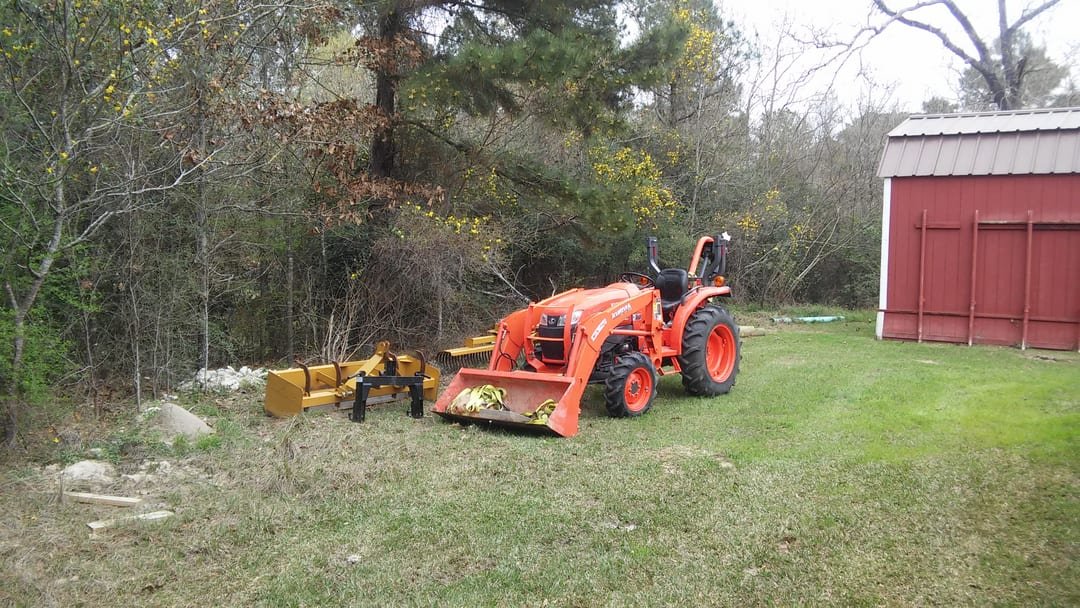
Slopes mean stepped or racked sections and more layout time. Soft or sandy ground near the lake means deeper posts and bigger footings. Rock, roots and old concrete slow the post holes. A fence line in brush or timber has to be cleared before it can be built, and clearing is real work. A back line you cannot get a truck to means carrying material by hand. None of this shows on a plat, which is why we walk the line.
Gates and hardware
A gate is the most expensive part of a fence per foot of opening: a braced or welded frame, heavy hinges, posts set deeper than the rest, and the labor to hang it so it swings and latches. Walk gates add a little; driveway gates add more; an opener with a keypad adds more again. Two fences with the same footage and one more gate are not the same price.
Post depth and bracing
This is where cheap fences get cheap. Shallow posts, no concrete, a corner without a brace: it saves money on the day and costs the fence years of life. We set posts below the soft soil in concrete, build H-braces on wire fence and give gate posts extra depth, and we do not reduce any of that to hit a lower number. If you are comparing bids, ask each company how deep the posts go and what is holding the corners.
Why we quote on site instead of over the phone
Because every factor above is invisible from the road. We come out, free, walk the line with you, look at the ground and the gates and the trees, talk through the styles that fit, and send a written price for that fence on that property. If you want two options priced, say so and we will price both. Request a free estimate or call (936) 933-2500.
Repairs are priced the same way
A repair quote depends on how many posts failed, whether the materials can be matched, and how hard the section is to reach. What affects fence repair cost goes through it.
Frequently asked questions
Why won't you give a per-foot price over the phone?
Because it would be wrong for your property, and a wrong number is worse than no number. Two fences with the same footage routinely cost very different amounts once terrain, gates, clearing and post work are counted. We would rather come look and give you a real price, free.
Is farm and ranch fencing cheaper than residential fencing?
Per linear foot, usually yes. Barbed wire and field fence on T-posts cost less per foot than wood privacy or ornamental metal. Corrals, pipe fence and game fence can cost more than a yard fence. It depends on the style, not the category.
Do gates add much to the cost?
Yes. A gate costs more per foot of opening than any straight run of fence, because of the frame, the hinges, the heavier posts and the labor to hang it square. An opener adds more. Gates are one of the main reasons two similar fences price differently.