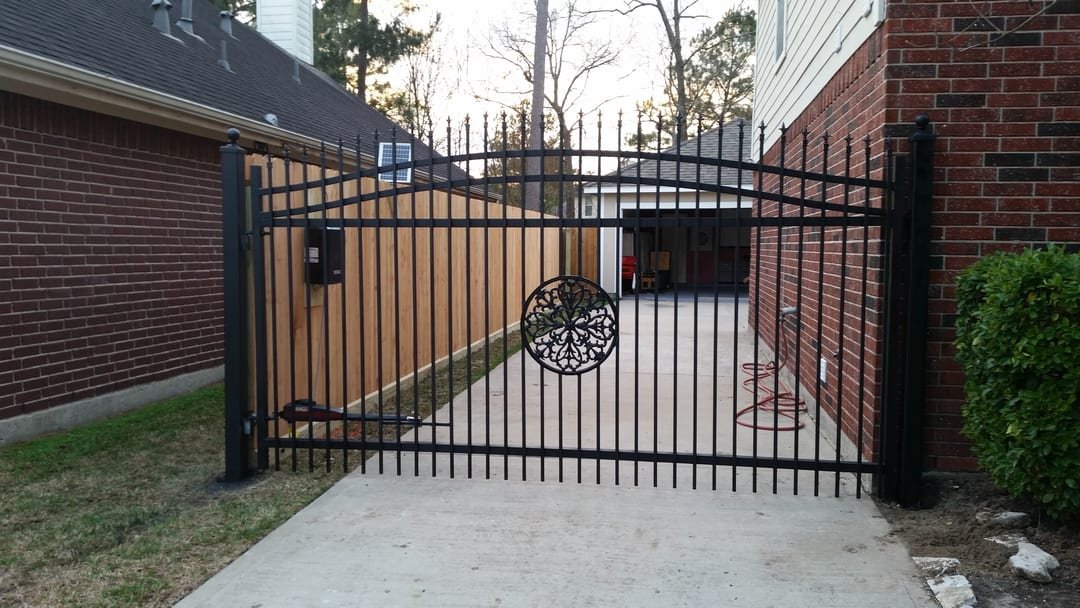
When someone calls asking for a wrought iron fence, what they almost always want is the look: black metal pickets, straight rails, maybe an arched gate with a finial on each picket. Almost nobody wants what wrought iron actually is, which is hand-forged iron that rusts and costs a fortune. The fence industry solved that decades ago. Here is what the terms mean now and how to get the fence you are picturing.
Wrought iron, ornamental iron, ornamental steel
Wrought iron is a specific iron worked by hand, and real wrought iron fence is a blacksmith's product. Ornamental iron is the old industry name for decorative metal fence of any kind. Ornamental steel is what is actually built: steel pickets and rails, welded or assembled into panels, powder coated in a factory. Ornamental aluminum is the same designs in aluminum, lighter and rust-proof. When we say ornamental fence we mean the last two, and they are what nearly every "wrought iron" fence around Lake Livingston is.
The parts
- Pickets, the vertical bars, in residential or heavier commercial weights, spaced for the job: tight for pools and small dogs, wider for a boundary.
- Rails, two or three horizontal members the pickets pass through or weld to.
- Finials, the decorative tips: spear, ball, quad, fleur-de-lis, or none (flat-top).
- Posts, square steel or aluminum, set in concrete footings sized to the panel and the gate.
- Gates, matched to the panel style, flat or arched, single or double, with adjustable hinges and latches or an opener.
- Accents: scroll panels, circles, rings, custom insets, a name on a gate.
Choosing well
Pick the grade for the job: residential weight for a yard, commercial for long runs, security and big gates. Pick steel for stiffness and large gates, aluminum anywhere the fence stays wet. Pick picket spacing to the code if it is a pool and to the dog if it is a dog. Pick black unless the house argues for bronze or another color. Keep the finials simple on a modern house and let them show on a traditional one. And match the gate to the fence from the start rather than finding one later. See ornamental fence, aluminum fence and ornamental gates.
What makes it last
Posts in concrete footings sized to the gate, panels attached with the manufacturer's brackets, every drilled hole and cut end sealed so the coating is not breached, adjustable hinges so the gate can be squared years later, and a touch-up kit for the day a mower chips a picket. Built that way, an ornamental fence looks the same in ten years as it did the day it went in.
Gates and openers
Most ornamental driveway gates get an automatic opener, and we install it with the gate so the posts and the opener are matched to the weight. See gate openers.
Frequently asked questions
Can I still get real wrought iron?
Hand-forged wrought iron is a custom blacksmith product and priced like one. For a fence or a gate, powder-coated steel in an iron style gives the look at a fraction of the cost and with far less rust to chase.
Does ornamental steel rust?
Powder-coated steel is well protected. Rust starts where the coating is broken: a chip, a drilled hole, a cut end. We seal every cut and touch up chips, and a rinse now and then keeps it clean. Aluminum cannot rust at all.
What is a finial?
The decorative tip on top of a picket: a spear, a ball, a fleur-de-lis. Finials are optional and set much of the character of the fence.